Sonic Territories: Wambuul is a multi-staged creative project consisting of storytelling, community events and the creation of art, centred on the Wambuul/ Macquarie River—taking in Wellington, Dubbo and Narromine. It’s been created on the lands of the Wiradjuri Nation.
This project has been developed on the traditional lands of the Wayilwan Nation, whose connections to the wetlands known as Maliyanga Ngurra*/ the Macquarie Marshes, dates back thousands of years. Pulse of the Wetland is the Australian component of the international MOSSES AND MARSHES collaborative project, exploring the connections, complexities and hidden layers of the wetland and surrounding floodplain as communities consider the future of this landscape.
Inhalare came about from the need to connect with other artists during periods of COVID restrictions and celebrate natural environments close to home that sustained us during those periods. The resulting artworks have been designed to be as accessible as possible to as many people as possible. There are 12 artists involved in this project from across regional NSW working in sound, text and visual art. MORE ABOUT INHALARE.
This project began with a residency at the CORRIDOR project near Cowra NSW in 2020. Over two months a series of field trips were undertaken around Wyangala Dam and downstream. A field trip to the Great Cumbung Swamp was made in December 2020. The project is ongoing as time and budgets allow. New work has been created from this project that will be released later in 2022. MORE ABOUT SONIC TERRITORIES PROJECTS
World Environment Day Lunchtime Listening Lab, Western Plains Cultural Centre Dubbo NSW (image: A Leggett)
Outdoor events involving technical equipment are always a gamble. Winter announced her presence early this year in the Central West of New South Wales, cloaked in cold southerly winds, showers, and overcast days with plunging temperatures in the week leading up to World Environment Day 2024 on 5 June. Of course, I had planned an outdoor listening event for the occasion.
I was part of a program of place-based interventions across the country by members of the ecoartspace Australian Dialogues, each of us marking World Environment Day by creating hopeful actions to address the issues impacting the environments where we live and work. This is the first of a series of events we’re planning over the next 12 to 18 months.
An urban setting was chosen for my Lunchtime Listening Labevent—not an environment I usually work in, or my personal preference. However, I believe an intervention requires one to go where the people are rather than expecting them to come to me. My event location was on the lawns at the front of the Western Plains Cultural Centre in the regional city of Dubbo—facing a busy street and close to the path leading into the gallery museum complex’s popular café.
A geofón in the base of a tree in the front lawns of the Western Plains Cultural Centre
With my background in communications, the event had been heavily promoted through social media posts and shares, support from the Cultural Centre team, posters in various spots around the cultural precinct and my local shopping centre, and an ABC Radio interview on the day. There was also great support from ecoartspace, promoting the events internationally. Still, you just never know who will turn up…if anyone.
I’d spent an hour setting up before the clock hit midday and I was worried. The lawn and the trees I’d planned to listen to were not producing the sounds they could, or that I wanted to showcase. The sounds on any given day will depend on the type of tree, the age of the tree, the time of day, the weather conditions, the seasonal conditions, watering regimes, and a host of other factors I have no control over. Nature isn’t a trick pony, and like animals, doesn’t always perform on cue. The lawns had been buzzing with electrical interference sounds I’d picked up a few days prior when I’d been sampling sound at the site in preparation for a wet weather Plan B, but then they went quiet too.
My event marketing had said you’d hear the heartbeat of a tree and the energy of the earth beneath your feet. I explained in my radio interview that this was just a hook—in the case of the trees, it’s often more like a grumbling tummy. But today, I was given the silent treatment. I’d spent hours promoting the event over two weeks and a day preparing equipment in the hope of wowing people with the magic of acoustic ecology and field recording, so this wasn’t ideal.
Listening to the trees and lawn at the front of the Cultural Centre
Fourteen people turned out in the cold to listen on World Environment Day. One of the early visitors was a woman who’d seen the event on Facebook and was unsure of what to expect. She was interested to know how the trees in this manicured urban lawn compared to listening to trees on the river. We spoke for several minutes about the differences and how deep listening to natural environments, without the use of technology, can lead you to a point of feeling the ground beneath you vibrating.
A boy of preschool age and his father arrived on the dot of noon. The boy sat on the camping stool next to the geofón plunged 20cm into the lawn, holding headphones against his ears. When he realised he could hear his feet stamping the ground, my footsteps around the tree, and his father running his hand over the grass nearby, he was captivated. Father and son left, returning half an hour later for a second round of listening. This child was hooked even though he couldn’t hear any invertebrate activity in the lawn or the gurgling and creaking of the trees. He left thinking about the idea of earthworms and grubs in the ground hearing his footsteps.
Over another hour, I had conversations with many more who turned up keen to hear something, but who were just as interested in the microphones and equipment on display, and my practice as a field recording sound artist. I also chatted about the SOIL+AiR creative future landscapes project and how listening to the environment will play a big role in that research over the coming year.
The Lunchtime Listening Lab event’s real impact was the stories shared about the environments we live in today, the choices we’ve made about what we surround ourselves with, the environments we aspire to live with, the environments we need for our future, and the need to listen—deeply.
Some were disappointed and less than impressed based on the formal and informal event feedback. I had set up a quick online survey for people to access via a QR code, as well as a blank notepad asking visitors to write a single word or phrase to describe what they experienced, felt or heard.
The responses were: peaceful, interesting, conversation starter, fascinating, thankful, mind opening…and not much.
I guess the not much comment was fair enough given the silence at this event. However, negative comments about these facilitated listening experiences remind me of something I heard after a live audience presentation of a soundscape I’d composed using ‘hidden’ and acousmatic sounds from the river. Because the audience recognised some of the sounds in the composition, they believed they heard these sounds all the time—ignoring or dismissing sounds they couldn’t make sense of, or attributing them to something more familiar.
The Lunchtime Listening Lab event’s real impact was the stories shared about the environments we live in today, the choices we’ve made about what we surround ourselves with, the environments we aspire to live with, the environments we need for our future, and the need to listen—deeply. These are critically important conversations to be having today and every other day of the year.
Extra: For those who missed this event or were disappointed with what they didn’t hear, the video below is a sample of sounds gathered from this same site a few days earlier (a rainy day Plan B exercise).These types of sounds are always best listened to with headphones or earbuds.
Sound samples from the Western Plains Cultural Centre in Dubbo recorded on 30 May 2024. Highlights within the samples are captioned. You can scrub through the video to find these points.
The Lunchtime Listening Lab was supported by Dubbo Regional Council’s SPARC Support Grant Program and the Western Plains Cultural Centre. A heartfelt thank you to all who braved a grey, cold day to learn more about listening to the world around us.
The Sonic Territories projects are centred on listening and sound — sampling sound with and without technology, and creating narratives around sound that reimagine spaces and places of the past, present and future. That 2017 work, titled Fictional Territories, was about a territory that can’t be defined, but a definition of territory as an area of creativity, with the territory emerging in the active experience of listening.
Since then there have been three Sonic Territories projects started—for Kandos as part of Cementa 2019, along the Galari/Lachlan River—as the result of a residency at the CORRIDOR project, and now a project centred on the Wambuul/ Macquarie River. There’s an open-endedness to these projects that allows them to inspire future works.
The Galari project currently only consists of a five-minute video, still under wraps as a competition entry. However, it’s a sonic exploration of the river’s story from the headwaters on the Breadalbane Plain to the Great Cumbung Swamp near the Murrumbidgee River, a source of life for tens of thousands of years, and whose post-colonial history has been shaped by many unintended consequences and promises.
Burrendong Dam wall, June 2022
The Wambuul’s story is similar. This Sonic Territories project focuses on a very small part of the Wambuul/ Macquarie River—from Burrendong Dam above Wellington to just below Narromine. The river’s health is managed in balance with the needs of the many stakeholders invested in having access to water—towns, farmers, industry, various recreation groups, First Nations communities, environmentalists of all stripes, and governments at all levels.
I’ve worked on issues of water politics for the past 30 years as a journalist, communications consultant, and now artist. Regardless of what hat you wear, it’s never easy to navigate the politics. Positions on water are firmly entrenched depending on if you have rights and access, or not. My creative work of the past decade has been about giving the environment a voice, as too often we talk around it, about it, in it and over it, but rarely do we stop to listen to what it has to say.
Biologist, David George Haskell writes in his 2022 book Sounds Wild and Broken: Listening opens us to the wonders of communication and creativity…Yet we are increasingly disconnected from sensory, storied relationship to life’s community…To listen, then, is a delight, a window into life’s creativity, and a political and moral act.
The era of the Anthropocene is strongly marked by hubris.
There’s debate presently raging in Dubbo about the future use of the floodplain area of Regand Park. It’s being fuelled by mistrust of past corrupt practices, misinformation, poor understanding of process and government responsibilities, personality politics and a fair pinch of shit-stirring. However, it boils down to an argument between those who believe the floodplain should be regenerated as a site of valuable riparian biodiversity, and those who believe that the area should be landscaped and managed for active and/or passive recreation. Some have even suggested the sides are split by religious alliances, which goes to show just how crazy the whole thing has become.
Dubbo Dispatch & Wellington Independent, 25 March 1911
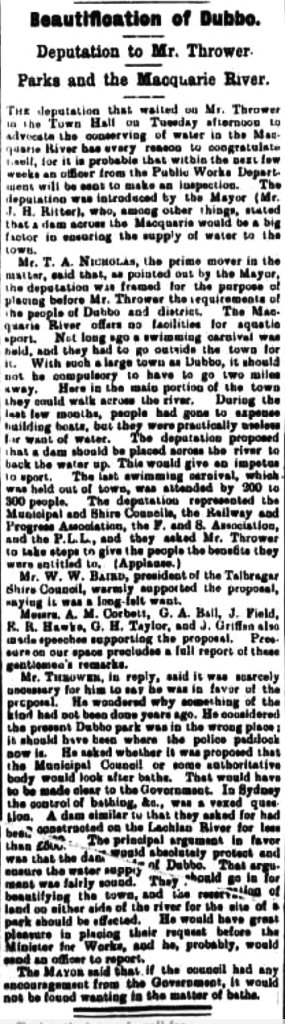
The call for developing ‘underutilised’ riverine assets in this country isn’t new. A quick dive into the National Library of Australia’s treasure Trove soon turns up stories dating back to 1911 and 1925 calling for the building of a dam or weir on the river to be investigated for the purposes of offering facilities for aquatic sports (1911) and beautifying Dubbo by having a broad sheet of water running through it (1925). By the late 1920s, a river beautification committee in Dubbo was in full swing.
A new century has since dawned, an age of environmental enlightenment on the back of the grassroots Australian Landcare movement of the late 1980s. Yet in 2017 Dubbo’s media reported on calls by a vocal and opinionated local government candidate for a recreation lake to be built in the city, claiming it was shameful Dubbo hadn’t managed to do so and that it was conservative, process-driven decision making that had throttled such an opportunity. It’s interesting to note this candidate had been a Landcare coordinator for some time. Progress clearly requires built environments and the taming of nature for human pleasure and prosperity to be truly enjoyed. Is there any doubt the era of the Anthropocene is strongly marked by hubris?
Our life with the more-than-human world is entangled, regardless of how many walls we construct, trees we clear, paths we pave, or land we flood, we don’t exist separately to the natural world. Despite becoming very good at pretending we have control, climate-induced natural disasters are proving otherwise, as we’ve witnessed and experienced in the past five years of droughts, dust storms, fires, and floods. We are at the coal face of climate change.
The future of the natural world very much depends on us—conserving and protecting it, so it in turn protects and supports us. How do we even understand this when there’s such an enormous disconnect from the more-than-human world we inhabit? In his recently published book Ways of Being: Beyond Human Intelligence, artist and writer James Bridle talks about considering other, non-human, forms of intelligence, writing: …taking them seriously requires us to re-evaluate not only our ideas of intelligence, but our idea of the entire world.
He continues: What would it mean to build artificial intelligences and other machines that were more like octopuses, more like fungi, or more like forests? What would it mean – to us and for us — to live among them? And how would doing so bring us closer to the natural world, to the earth which our technology has sundered, and sundered us from?
Taking the time to listen to the river in its urban setting on the Wambuul Soundwalk through Biddybungie Reserve in West Dubbo, August 2022
We must make peace
Deep, active listening is about pulling apart what we think we know about our place in the world, experiencing it in a new way and reimagining the future—today and in a time beyond us. Listening to the scratchy, pulsing heartbeat of an ancient River Red Gum on the banks of the Wambuul, the crackle and pop of water moving inside native grasses on the overgrown reserve by the water, or the crickety clicks of water insects in a flooded stream is a privilege and a delight that proves there is far more going on in the world around us than our self-absorbed lives allow us to acknowledge. You don’t need to be a scientist to understand that.
Our spoken word human stories of the past and connections with the environment are important in our consideration of the future. Our time on this earth as a species has been relatively short but we’ve had such an enormous impact. If we are to have a future, we MUST make the time to remember, to listen—really listen, and (re)think about where we’re going and how we’re going to get there; acknowledging our mistakes, saying sorry when, where and to whom we need to, moving forward together. You might think this sounds like reconciliation. It is—with our environment. We must make peace.
Take the time to explore the surroundings in your backyard and reconnect with the earth, air and water, breathe and listen, eyes closed against the glare of progress, development and demands of productivity. It costs nothing. That time might just slow the momentum we’re using to throw the future of our species to the wind. Imagine if we could find common ground with those whose positions are diametrically opposed to ours. Imagine if we could reconfigure our sense of belonging and place in history and the world to create a future thriving on entanglement with the more-than-human world. Just imagine.
Sonic Territories: Wambuul was funded by a Country Arts Support Program grant through Create NSW and Orana Arts. A fourth artist position in the Sonic Territories: Wambuul creative team was part-funded by fundraising through the Australian Cultural Fund.
Listen to the Wambuul bila soundtrack and explore the Wambuul stories.
Eyes closed, breath soft, body relaxed, our ears are tucked inside headphones directing sounds from the microphone on the metal wall, into our bodies. Cavernous, reverberating thrums pulse, twang and groan as the wind and movements in the soil beneath the converted shipping container play the structure like an instrument. Beyond the headphones, woodland birds call out, engine and tyre noise can be heard from the nearby road, suburban sounds of the weekend football game, whipper snippers and a dog barking drift to the edge of town.
LOM geofón attached to the bird hide with the neodymium magnet, recording into Zoom F6
This whole-of-body sonic experience was part of the MOSSES AND MARSHES soundwalk at the Tiger Bay Wetland near the Window on the Wetlands (WOW) Centre at Warren NSW—the new home of the MOSSES AND MARSHES exhibition for the month of July. The walk and an artist talk were part of the opening weekend of the exhibition and the last in the public program funded for the Australian leg of the project.
An earlier attempt to run a soundwalk in the Macquarie Marshes as part of the events program at the Outback Arts gallery in Coonamble was washed out in late May. There was a great deal of weather watching in the week leading up to the weekend of 2 July with rain forecast across large parts of NSW that has since led to considerable flooding across the State. What’s been bleak for travel and outdoor activity has been a boon for the wetlands.
Under gloomy (but almost dry) skies, 10 of us set off with a tub of listening equipment. There was lots of chatter as we made our way towards the wetland. It was at this point the listening part of the soundwalk started. My first directive was for everyone to be quiet and note what they heard on the short walk to the bird hide, as they were going to be asked what those sounds were and describe them. Sometimes we lack adequate words to describe what we hear. We have many onomatopoeic words in English but they often become clichés, like the wind sighing in the trees or the twittering of birds.
This exercise also prompted a discussion about what we consider noise and how that might impact the words we choose to describe sounds. Is it mechanical or man-made sound, or can natural sounds be considered noise too—thinking of how annoying crickets, dogs, frogs and cicadas can be?
Going back to the short walk to the bird hide, we talked about the direction of sounds and how man-made structures like the bird hide (a converted shipping container), levy banks like the one nearby, vegetation, and our individual ability to hear can distort our sense of direction or amplify/dampen sounds. This conversation turned to the design of urban environments through sound and the impact noise has on some species and their ability to communicate and reproduce.
Closing our eyes, we listened again—honing in on our auditory senses for sounds dominating the wetland environment of Tiger Bay. The questions that followed were about what we wanted to hear more or less of. Traffic, whipper snippers, and barking dogs were top of the list.
Kim V. Goldsmith at Tiger Bay Wetland, Warren NSW
At this point, it’s worth mentioning that more-than-human species are listening out for us as much as we’re listening for them, so there were not a lot of wetland birds to be heard. The frog song on the day was also distant. This was when I shared how much waiting and active listening goes into being a field recordist, well before you ever hit the record button. You need to be accepted into that environment before you’ll hear what you were expecting to hear…and not always then.
Before we pulled out the microphones to listen to the sounds of the bird hide, the trees, vegetation and the lagoon, we touched on a really important topic — the loss of acoustic biodiversity. It’s a big field of research, but someone who has written about it recently in a way that hits home is David George Haskell in Sounds Wild and Broken. Well worth the read.
Our microphone play consisted of using the LOM geofón on the bird hide with the neodymium magnet, as well as using the geofón’s probe in the base of a tree by the lagoon. We then pulled out an Aquarian H2a hydrophone for some water listening, placing it in the rotting couch grass on the edge of the lagoon, and then using a boom pole to place it into deeper water near the reeds. The hour was soon up before we had to return to the WOW Centre for the next part of the afternoon’s program.
The soundwalk experience certainly put me in country, utilising the underrated sense of hearing and hugely contributing to my experience of the place, in ways I hadn’t thought of or felt previously. My depth of experience was greatly increased by hearing the sounds previously unheard and quite unimagined. I loved the sound the wind made in a metal space—the bird hide, water moving in the pond and the breathing of the tree, or was it siphoning water, or both…?
JUDE FLEMING, WARREN
Images: Cameron Porteous
The following audio samples were recorded the day after the soundwalk using the same equipment and locations. Some sounds heard on the day of the walk were not present the next day, such as the wind through the bird hide and gurgles at the base of the tree. There were also more birds present when I returned alone, picking up the sound of swamp hens and kookaburras through the geofón and hydrophone.
After returning for the artist talk inside the old church at the WOW Centre, I asked the walk participants what sound they remembered most from our time in the wetland. The answers were varied but those who responded expressed a sense of wonder and connection with this sliver of wetland on the edge of town. For some, it was an experience that will stay with them.
Kim V. Goldsmith talking about the MOSSES AND MARSHES project (Image: Shona Whitfield)
Kim Goldsmith’s approach, the scope of her activities and the detail gathered, demonstrated the complacency with which we can accept what we have as the norm. When sharing Kim’s point of view, and her deep listening, I am now more aware of the potential loss occurring in our natural world. This leaves me with a desire for a more abundant landscape visually, audibly and environmentally, and a recognition that all three are intrinsically entwined.
JACK RANDELL, DUBBO
The video and sound works from MOSSES AND MARSHES will be at the Window on the Wetlands Centre (in the Visitor Information Centre) until the end of July 2022. The MOSSES AND MARSHES book and postcards are also available for sale from the WOW Centre during this time.
This MOSSES AND MARSHES event was made possible with support from the NSW Government through Create NSW. It has also been supported by the Australian Cultural Fund, Outback Arts, RiverSmart (Window on the Wetlands Centre), and the Macquarie Wetlands Association.
Photo of Clementine Belle McIntosh at work on the Murrumbidgee River/ Marrambidya (supplied)
Challenging and changing the way we think about our art practices
By Kim V. Goldsmith, lead artist and Inhalare project coordinator
When the idea for Inhalare/ breathe upon was first floated, I never imagined it would be as challenging and intriguing as it has become.
The challenge has been to learn quickly about accessibility and what that means when producing not only artworks but an exhibition. The intrigue has been to see how artists in both stages of the project have responded to their prompts.
The brief sounds simple enough at first — Stage 1: produce a soundscape of more than 5 minutes duration and write 150 words about an environment in your backyard you came to know well during COVID lockdowns or periods of restricted movement. Then in Stage 2: produce a visual response to the soundscape and/or text provided about that environment without being able to visit it.
The more poetic version is six artists explore a natural environment close to home, developing soundscapes and writings to prompt the creation of visual works by six other artists, capturing deep connections and hidden layers, and allowing imaginations to explore these environments — making the familiar, unfamiliar.
The brief that challenged
“…there’s that level of blind trust that you have to go forward with.” – Andrew Hull
The project brief was unsettling for some Stage 1 artists, who expressed concerns about the word limitations or the prescriptive nature of the exercise. As the writer of the brief well used to writing social media captions and short-form journalistic editorials, I must admit the 150-word count challenged me too.
Andrew Hull expressed his concerns in a video interview at the end of the first stage of the project in November 2021.
Andrew Hull talking with Kim V. Goldsmith on Zoom, November 2021 (video still)
I don’t know in producing this piece and assembling these words, how much I’m prescribing to my collaborative artist — who I don’t know, I don’t know what they know and will they understand my experience of being in that landscape?
So, I’m anxious that I’m overprescribing, and I’m anxious that they won’t get it all, that they won’t see the place that I know…but that is what is and they’ll experience something from what I’ve given them.
But my terror is that I’ve tried to describe this rocky gorge, with a creek and atmosphere and it turns out looking like a beach or something else. So, there’s that level of blind trust that you have to go forward with.
Stage 1 artist, Jason Richardson of Leeton said, The best remote collaborations I’ve been involved with have strict guidelines and this project offered good directions to develop my contribution.
The field recording was straightforward and the word limit for the written component was useful, both for my process and, I expect, also for the audience.
Extending our thinking about art
…we look to lead galleries to move past passive visual consumption of contemporary art and other art forms. – Allison Reynolds
What if you’re unable to hear or see the resulting works? What if the idea of entering a gallery creates a sense of great anxiety, excluding you from any of it? How do you provide access to the works for anyone who wants to experience the exquisite sounds recorded in the rainforests of the South Coast or the eerie tension of a rocky gorge in a remote western NSW National Park? Does a 150-word piece of prose or poetry adequately describe that environment?
How do you describe a visual artwork so someone with sight impairment can experience or understand what hangs before them, or what it is they might hold in their hand? How descriptive should an Audio Description (AD) be to achieve that?
These are all questions the artists in Inhalare had to grapple with during the development of their work as they prepared for an exhibition designed to be accessible by everyone. That exhibition is now showing at SPACE in Coonabarabran, along with a range of accessibility supports.
The exterior of SPACE, a gallery and creative space in Coonabarabran NSW
SPACE is the only disability-run gallery in regional NSW, headed by accessible arts advocate, disabled artist and gallery director, Allison Reynolds, who is generous with her knowledge, time and passion for making the experience of art accessible to everyone.
Art is an experience, and it is so important to me personally and to SPACE and its mission, to ensure all facets of the experience are available to everyone by designing the exhibition with that in mind from day dot.
As the only disabled-run gallery in regional, rural, and remote New South Wales, we look to lead galleries to move past passive visual consumption of contemporary art and other art forms.
For most of the 12 artists involved in the Inhalare project, the art forms they worked with — be it sound, writing, printmaking, painting, photography/bookmaking, textiles or mark making on glass, were familiar processes. But each artist was tasked with the challenge of working beyond their comfort zone in considering access by audiences who may have never been able to experience their work before.
New audiences
“I love the inclusiveness of this project.” – Carol Archer
To meet the brief, soundscape producers/writers were required to provide an audio recording of the text works. The visual artists were required to provide audio description scripts and recordings for their visual art responses.
As the lead artist and project coordinator, making this happen cohesively required regular, sometimes lengthy communication with the project group. There were many timeline updates and some detailed ‘how-to’ information to ensure the content details were consistent and the audio recordings of a high standard.
Often, I had to find out how to do something before sharing it with the others — like how to write a good Audio Description. Overseeing these efforts was Allison Reynolds, who would be the one pulling it together as curator of the Inhalare exhibition.
Carol Archer at work printmaking (supplied)
Visual artist Carol Archer from Bulahdelah produced a print in response to the fire-impacted landscape at the heart of the soundscape and text of Danja Derkenne from Little Forest (near Milton/Ulladulla). Carol replies to my emails: I love the inclusiveness of this project. I worked quite hard on the audio script to fulfil the brief and do justice to the work/concept— an interesting challenge, which I quite enjoyed.
My wish is for audiences of Inhalare to find surprises and joy amongst the works, just as the artists have as they listened, read or visualised the works created through this remote collaboration.
Greg Pritchard recording beside Marrambidya Bila/ Murrumbidgee River (supplied)
Wagga Wagga artist, Greg Pritchard provided what he described as a ‘turbulent’ sound recording of the Marrambidya Bila (Murrumbidgee River) to emerging Gilgandra artist Clementine Belle McIntosh, resulting in a surprising response.
The work Clementine made, inspired by my soundscape, is so beautiful and I was not expecting that given the turbulence of the river I recorded.
Lasting impact
I felt the Inhalare project reached out through the darkness of the once in our lifetime pandemic with opportunity, hope and companionship. – Vicki Luke
It’s humbling to take a step back and look at the impact this six-month project has had on the practices of the artists involved — some of whom have been in practice for decades and others, like Clementine Belle McIntosh, for only a few years.
This project has been a great experience as an emerging regional artist — to be able to collaborate with an artist from a different place and material background was beneficial in enabling me to broaden my own perspective of regional NSW, but also the similarities that string its large geography together.
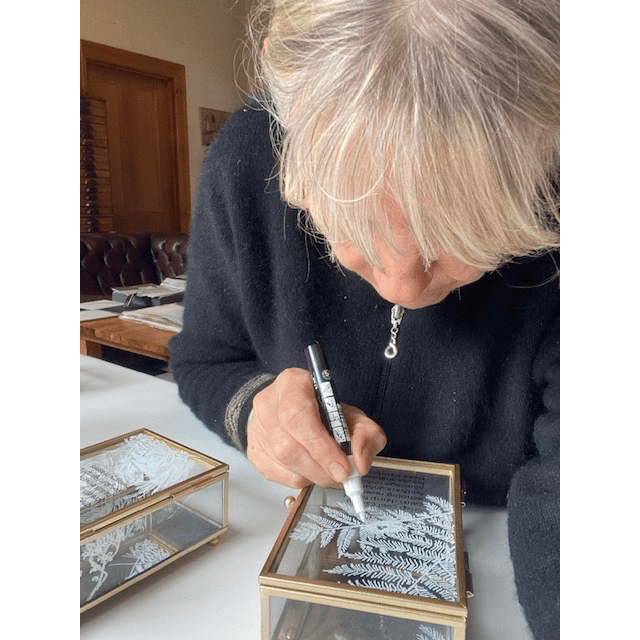
Vicki Luke at work on her Inhalare artwork (supplied)
For established Albury artist Vicki Luke the project offered a lifeline at the end of what had been an incredibly difficult time for many artists.
I felt the Inhalare project reached out through the darkness of the once in our lifetime pandemic with opportunity, hope and companionship. I am a great believer in collaboration, so the thought of sharing like minds across NSW was very refreshing.
Covid has made us feel very remote here on the border of NSW and Victoria, after over 200 days of border restrictions. The divided community hunkered down to make the best of things but it was very tough especially as there was little support or sympathy politically.
That feeling of powerlessness has been mitigated by remote collaboration. I have gained confidence from the Inhalare project as I see my colleagues successfully navigate through these difficult times, and it gives me the impetus to keep going.
It’s going to be hard to top that.
The official opening of Inhalare/breathe upon at SPACE is on Saturday, 11 June (invitation only) with a special message from Accessible Arts CEO, Liz Martin, officiated by Orana Arts Executive Director, Alicia Leggett.
Inhalare/breathe upon has been funded in stages from a COVID Development Grant through Create NSW (Stage 1), crowdfunding through the Australian Cultural Fund and private funding (Stage 2), and a CTA Experience Marketing Campaign Grant provided by Regional Arts NSW through the Regional Arts Fund, an Australian Government initiative (Stage 3 marketing). The project has also had support from Orana Arts and SPACE.
ClimateCultures is a network of over 200 artists, curators & researchers in many countries, including across the UK and other parts of Europe, as well as in North America, Australia, and India. Andrew Howe and Kim V. Goldsmith are members of ClimateCultures.
Creating multiple points of connection to our backyard environments
Kim V. Goldsmith, lead artist and Inhalare project coordinator
During 2021’s COVID lockdowns and periods of self-imposed isolation, I walked my back paddock several times each week, often photographing or videoing these walks on my phone. Sometimes I made sound recordings with a binaural headset.
The area I traversed is encased by my garden fence to the south, and rusty barbed wire and ring lock fences shared with neighbours to the north, east and west—patched and pocked with kangaroo holes. It’s about 10 hectares (or 25 acres). Having lived here for 13 years, I thought I knew it well. When thousands of kilometres away on the other side of the world as I was in 2019 (pre-COVID), I can visualise it in fine detail—the cool, dark tree-lined gully, ducks swimming on the dam, thickets of lichen and moss-covered cypress pine, giant black-red ironbarks oozing sap and scrubby wattles, the high, exposed quartz-jewelled ridge where the kangaroos camp, and open, grassy woodlands with giant box trees.
The sounds that are part of this small parcel of land are the sounds of home for me, as my home and garden are part of this landscape. They include the song of dozens of woodland bird species, frog song after rain, crickets, the rustle of a breeze through the grass, wind in the tops of the trees, overhead planes coming into land north of us, the neighbours’ barking dogs, crowing roosters, screaming children, revving engines, thumping bass, leaf blowers, and lawn-mowers—all part of life on the peri-urban fringe.
Always looking for projects that excite me and keen to create an opportunity that would connect me with Australian artists whose work I respect and admire, I started thinking about a way of allowing these backyard environments to be further explored, peeling back their layers to discover or rediscover new or hidden elements such as the subterranean sounds I’m so fascinated by, in turn, reconnecting with these places that sustain us during times of restricted movement with a renewed appreciation.
My thoughts initially swirled around just the sounds of these environments, but the challenge of writing in a new, succinct way where each word carried weight, and challenging artists to respond to these sounds and words without being able to visit the places that evoked them, became an intriguing prospect. So, the idea became multi-staged.
Transforming familiar landscapes into unfamiliar territories
The idea of breathing upon places in our backyards seemed appropriate for the times.
Approaches to the first group of artists were made in early August 2021. Only one artist on my list said they were too busy, everyone else was excited to see where this would go.
It was a leap of good faith on the back of a proposal that documented some ‘loose’ ideas under the title of Inhalare, the Latin word for ‘to breathe upon’, more often used by singers using a technique called inhalare la voce or inalare – to ‘inhale the voice’. The idea of breathing upon places in our backyards seemed appropriate for the times.
The six artists who ‘signed up’ were given a brief with ideas about the colonising use of language and its inadequacies to communicate experience and express communion with the more-than-human world. I added ideas of deconstructing language, humanising the natural world, and reconstructing familiar territories in new ways. I referenced the writings of Charles Foster, Donna Haraway, Anna Tsing, and Lesley Head, and invited each artist to produce works that allow others to hear, feel, and taste these places. Nothing too challenging.
Danja Derkenne, pyronema (fire fungus) of Little Forest
Following a successful grant application for COVID money put up by Create NSW in the second half of 2021, by mid-December 2021 I had six edited soundscapes and short text works of 150 words or less. This was just the first stage. Our text editor was Dr Liz Charpleix, who I’d worked with on the Mosses and Marshes book.
The Stage One artists are Andrew Hull (Bourke/Mildura), Danja Derkenne (Little Forest), Dr Greg Pritchard (Wagga Wagga), Anna Glynn (Jaspers Brush), Jason Richardson (Leeton), and me, Kim V. Goldsmith (Dubbo).
Dr Greg Pritchard recording by the Marrambidya/ Murrumbidgee River near Wagga Wagga
The challenge of creating multiple points of connection
These works are as much for the more-than-human worlds we’re celebrating as they are for our human audience.
The six soundscapes and writings covered a vast range of natural environments across New South Wales from the rainforests of the South Coast to a national park near Bourke in Western NSW, the Marrambidya/ Murrumbidgee River near Wagga Wagga and wetlands near Leeton in the Riverina, to the Callitris glaucophylla (white cypress pine) thicket of my back paddock near Dubbo in the Central West.
With the support of NSW regional arts organisation, Orana Arts, we hosted an online roundtable event in mid-December so the Stage One Inhalare artists could talk about their work and environments. It was the first time they had come together. It was also where the Stage Two artists were named and introduced. These were the artists who would be responding ‘blindly’ to the soundscapes and text works, creating an A4 sized work about the site without being able to experience it for themselves. Thankfully, all six of the visual artists on my list for Stage Two had responded with a resounding yes to my project pitch.
The second stage of the project kicked off at the start of February 2022. This part has been much harder to fund, as it falls between funding rounds and is the start of a new year that is just warming up. I’ve been running a crowdfunding campaign for Inhalare through the Australian Cultural Fund (as part of a year-long ecoPULSE campaign), but we haven’t quite made $1,000—about $2,000 short of what is needed to pay the artists. This is where artist/ project managers dig deep, investing heavily in the projects we initiate. Most of the artists have been prepared to produce work without the fee, but that’s not equitable or fair.
It’s now the end of February—the first month of a two-month creation period now over. The visual artists are at different stages of developing their responses. As I did with the Stage One group, I check in every two to three weeks to see how everyone is progressing, and update them on plans for the project. One artist has already completed her work—a stunning response to a stunning soundscape and text. Others are still working through ideas. Like the Stage One artists who were challenged by the possibilities and complexities of their chosen environment, or the much remarked upon word count restriction, the visual artists are being challenged in different ways. There’s excitement, but there’s also the weight of expectation of dealing with the work of another creative and a responsibility to the environment we’re creatively exploring.
This period of contemplation prompts a deeper connection with and appreciation of the layers within natural environments that invite us to draw closer, to listen more carefully, choose our descriptions more wisely, to engage our imaginations, emotions and senses. These works are as much for the more-than-human worlds we’re celebrating as they are for our human audience. To do any of this successfully, we need multiple points of connection.
The Stage Two artists are: Vicki Luke (Table Top), Libby Wakefield (Southern Highlands), Dr Carol Archer (Bulahdelah), Clementine Belle McIntosh (Gilgandra), Edgar Alvarez (Coonabarabran) and Amanda Thomas (Lake Macquarie).
Art and the environment are for everyone
Stage Three of Inhalare is about presenting the sound, text and visual works. One of the elements added to the project early on was the idea of making the artworks as accessible as possible to everyone, regardless of age or ability. It goes back to the idea of multiple points of connection. We’ve included audio recordings of the text works, audio descriptions of the visual works, and a range of accessibility elements are being planned for the website to digitally support the exhibition in its physical space.
With the possibility of a grant to help promote and develop the accessibility elements, all 12 artists committed to a show at SPACE Gallery in Coonabarabran for mid-May 2022. This will be the first time all the works come together, allowing for not only multiple points of connection to the environments at the heart of the project, but multiple points of access to them.
SPACE Gallery is run as a not-for-project social enterprise space in a town that’s the gateway to some of the State’s most beautiful and interesting natural environments—the Warrumbungle Mountains and Pilliga Forest. It’s run by its founding director, Allison Reynolds, an artist and passionate arts accessibility advocate who is also part of an artist-run initiative in Coonabarabran for artists with disabilities. Her guidance and support are going to be critical to getting this point of connection right.
The hope is that once we see how the elements work together, we can take it one step further with the sound artists/writers and visual artists collaborating to develop more expansive, immersive, multi-faceted creations for bigger gallery spaces, maintaining the accessibility elements that allow for a more inclusive and memorable creative experience for all.
What’s the end game?
Audiences need to start where they are now, but to do so they must have access in a way that invites or excites.
Initially, this was an excuse to work with artists I’ve long wanted to work with. Making art in regional Australia can be isolating and connections with like minds is critically important to my practice. Inhalare has also more than met the ecoPULSE brief I set in 2020 of exploring regional futures through enquiry, creativity and connections. The project has become so much more than either of those objectives.
As an environmental artist, I always hope to create enough interest in my work that might lead someone to think about the natural world a little more, or a little more deeply. To think they might be inspired to ask a question, look something up, explore their local neighbourhood or further afield, learn more about or act on an environmental issue is a bonus. Audiences need to start where they are now, but to do so they must have access in a way that invites or excites. I believe Inhalare can do that.
Inhalare/breathe upon will be at SPACE Gallery, Coonabarabran, from 15 May to 16 June. Further details to come.
ecoPULSE is a web-based project platform developed by Kim V. Goldsmith in 2020 to provide an online ‘home’ for collaborative environmental and social ecology projects across regional territories of Australia and beyond.
The artists’ response to the Mosses and Marshes International Panel Discussion
In early November 2021, an international panel was convened to discuss the entangled in alternative ways of thinking about, understanding and valuing special environments. The goal was to determine if we needed to consider different ways to inform and shape the future of the Fenn’s, Whixall and Bettisfield Mosses and Macquarie Marshes, and environments like them.
Jessica Moore Dubbo Regional Council
The online event was organised in partnership with Dubbo Regional Council in New South Wales, Australia (part of the Macquarie catchment), and facilitated by their Cultural Development Coordinator, Jessica Moore.
The panel consisted of natural resource managers, scientists, academics, and cultural consultants from Australia and the UK with a wealth of experience in land and natural resource management issues. They were Tim Hosking (AU), Kate Mildner (AU), Fleur and Laurance Magick Dennis of Milan Dhiiyaan (AU), Dave Pritchard (UK), Dr Tim Acott (UK) and Robert Duff (UK). There were also six provocateurs from both countries raising issues that were then addressed by the panel, in front of an audience on Zoom.
As organisers of the event and co-leads of the Mosses and Marshes project, Kim V. Goldsmith and Andrew Howe see it as just the start of many more conversations to come, online and offline in their respective communities as well as globally.
These are their thoughts following the event.
Maliyanga ngurra/ Macquarie Marshes, 2020
KIM: I remember when the conversation started between us about the possibility of an international panel event, I was putting together a grant application over the summer of 20/21 to include public programming around the project from my end. I think was looking for a way to pull our two wetlands together in both my mind and the mind of the public — to show that while there are differences and we’re separated by huge distances, we have so much in common. My thinking took shape around what that might look like off the back of an email sent to you from the Ramsar Culture Network’s Dave Pritchard in July 2020, where he wrote: I’d be keen on anything that expands perspectives on intangible values (such as aesthetics,creative inspiration, sense of place, re-framed understandings of environmental change etc), explored through ecological or socially-engaged arts-based enquiry, as part of the rubric of “cultural ecosystem services” in the Ramsar Sites context. That definitely had me thinking!
Andrew, what were you thinking about how this event might fit into the project and its objectives, before the event?
ANDREW: Objectives I had in mind for the project included using art to build stronger connections with the natural environment, to transform how we think about a place and a changing environment, and to imagine how interdependence between humans, land and ecosystems might build sustainability. I thought the panel could contribute to each of these objectives, and particularly the last of them. Considering interdependence requires an understanding of multiple perspectives and I saw the event offering great potential to bring many voices together from two geographies that could not be further apart.
You and I both have backgrounds linked to environmental science and the arts, and we have tried to maintain multiple lines of enquiry during the project and in our dialogue. During our global collaboration, we have both communicated with many different people connected with the wetlands from scientists, land managers, other artists, writers and members of the local communities. But all of these conversations must ultimately be filtered or mediated by the two of us in steering the art project. So, I saw the panel event as a means of expanding the debate in an entirely different way. Bringing those different disciplines/areas of interest and different cultures directly into contact might just make sparks fly to raise issues we could not have brought to the fore ourselves. And yes, like you, I hoped that despite the differences between the Mosses and the Marshes, we might find there are more issues in common than perhaps we imagined.
David Duncan (panel event provocateur) standing beneath an ancient coolabah tree on the floodplain of the Marshes, February 2020
KIM:Fast forward several months to a successful grant application and the signing of a partnership agreement with Dubbo Regional Council to facilitate the event, we brought together six panelists and six provocateurs (from the UK and Australia) in front of a live, international audience on Zoom, on 11 November, to consider and discuss alternative ways of thinking about, understanding and possibly valuing special environments like the Mosses and Marshes, to help inform and shape their future. It felt like a big moment. There’d been a lot of planning and preparation to get to this point and at times I had to keep reminding myself that it was us, as artists, who had managed to make this happen.
What did you think we might achieve once that Zoom session was underway?
ANDREW: It was something of a leap of faith because you and I were not participating directly in the debate nor were we the facilitator. We had curated the event by selecting the panelists and provocateurs with some guidance to them around the topic, but from there on everything was dependent on what people actually said on the day. I just hoped that we could achieve a sufficiently comprehensive, informed and robust coverage of relevant issues with responses from all the participants so that it would be possible to identify where there was consensus (or at least recognition of similar views), points of contention and areas of uncertainty. The discussion might spur some of the participants into taking actions to follow up or respond to some of the issues. As we have found, the discussion has been extremely fruitful in yielding a range of issues for us to highlight and make further provocations for action.
Kim, there were a few variables to pin down in deciding on the format for the event, what did you find to be the main decision factor?
KIM: Having run a few online talk events over the year leading up to the panel discussion, I had started to work out what worked and what didn’t. I’ve always been a fan of ABC TV’s Q&A TV program format, and couldn’t see why something similar wouldn’t work on Zoom.
I know we spent some time considering the topic and whether to explore intangible values alone or be more provocative by suggesting alternatives. I think Dave Pritchard set the record straight at the start of the panel discussion, saying it’s more about being clever with allowing a plurality of multiple values operate together, inviting challenge and reframing the questions to find new solutions to some of the issues we’ve been exploring…and that’s where artists can play a role. He also mentioned the need for a more holistic approach to understanding what makes a place. I think this is where the stories shared with Fleur and Locky Magick Dennis from Milan Dhiiyaan became so powerful in this discussion. These experiences and perspectives are not often shared with an international audience, or as we found out, even within our own regions.
ANDREW: It was important to hear Fleur and Locky speaking so powerfully with an emotional depth that could only come from an intimate, authentic connection with the land and its people. Their references to the missing sounds in the landscape, the urgent need for resources to gather legitimate community representation and a fundamental lack of access to Country made for uncomfortable, but necessary, listening. What they had to say aligned with other indigenous cultures across the globe around honouring what the Earth provides, taking only what is needed and acknowledging that we are all custodians and not owners of the land.
These basic sustainable principles are in direct opposition to prevailing systems for exploiting land and resources in most parts of the world. It feels like an impossible seismic shift is needed to change attitudes towards these basic principles in a river system with so many competing interests like the Marshes. What signs of hope do you see?
KIM: It does seem like an impossible seismic shift is required, and not just in the Marshes. Maybe in the interim, it’s about accepting that scientific and evidence-based languages aren’t the only way of knowing and doing, particularly if we accept that language often shapes behaviours. The acceptance of Indigenous knowledge bases seems to be long overdue, and I think that came through in the discussion.
ANDREW: So Kim, what do you think were the key themes emerging from the discussion?
KIM: Plurality of perspectives and values, along with a more holistic approach and access (including safety or feelings of safety) were distinct themes throughout the discussion. I do think the diverse backgrounds and experiences of the panelists and provocateurs that came together for this event underscored the need we have for diverse knowledge bases and perspectives, and ways of understanding how wetlands are meaningful and important to people, to use Tim Acott’s words.
ANDREW: There is a trend towards recognising “softer” or intangible values associated with wetlands and other natural landscapes in decision-making alongside the measurable social, environmental and economic values. Natural capital is commonly referred to in projects and methodologies are becoming more established for taking this into account. But other cultural values, like memories, stories and sense of place, are some way off from finding a means of being accounted for in a balanced, holistic decision-making framework.
KIM:I agree. It’s a bit too far to the left of those scientific or evidence-based values. Perhaps the adoption of Indigenous knowledge though might make room for some of those other ‘softer’ cultural values. We’ve started that process in a small way by collecting audio stories and providing room for the community to contribute to the conversation.
A few times in the panel discussion, the need to broaden our timeframes was raised, particularly on a policy level – which as we know is so often determined by political cycles. Was this something you were thinking about at all when we started this project? I’m not sure I was thinking of this as an ongoing project when we first started talking in 2019, but it seems inevitable now that there’s a need for it to be ongoing. Don’t you think that too is a short timeframe compared to how we need to be thinking about the future of the wetlands?
ANDREW: History in the landscape is always something that interests me, and as I came to know the Mosses, I realised that it had a story going back 10,000 years to at least the last Ice Age. And so that was one comparison I was interested to make with the ancient landscape of the Marshes. However, I wasn’t necessarily thinking very far into the future. The climate and biodiversity crises are upon us and demanding short term action. When Robert Duff talks about the restoration of the peatbog taking many centuries to recover, that is a timescale that I was certainly not thinking about when we started on the project. It has certainly registered in my thinking now, and I feel challenged to explore notions of cyclic time, parallel timelines and other alternatives to linear timelines.
I was open-minded about how long the project might continue. I knew if I invested time, energy and creative thought into a place, I would inevitably become attached. I have no ancestral roots in Shropshire, although I have lived here for 24 years, but having got to know the landscape and some of the people associated with the Mosses, and having learnt more about the Marshes, I feel a commitment to “seeing things through”. As long as the project offers interesting challenges for my artist practice then I’ll be keen to keep the project going.
Kim V. Goldsmith (artist), Shona Whitfield (provocateur, Window on the Wetlands Centre), Kate Mildner (panelist, landholder from Warren NSW), October 2021
KIM: A couple of the key things that came from the event that I want to follow up on are first, the issue of bringing more voices to the table (including future generations), and secondly, access to the land itself for those here now. The Values. Voices. Action. consultation as the follow-up to the panel event is just the start of this for me. I think more might happen even within some of the government departments that had representatives at the event. It’s going to be important to listen to those here and now about what we’re doing today (regular self-reflection required) – even if we don’t agree with them, as a provocateur, Anna Martin of the Shropshire Wildlife Trust put to us. Where do you see it going for you at this stage in the project? After all, you did say at the end of the panel event that this was possibly the end of the beginning!
ANDREW: This aspect of the debate brought to mind that my namesake, Sophie Howe, was the world’s first and so far, only Future Generations Commissioner, a role she has held for the Welsh Government since 2016. She has led high profile interventions around transport planning, education reform and climate change. This is the kind of future planning cutting through the short-termism of typical political cycles that must continue to be adopted elsewhere.
I think there is a discussion to be had with those involved in planning and managing wetlands or associated restoration projects to see whether creative approaches led by artists, like the Community Voice Method described by Tim Acott, could work alongside other engagement approaches to help support decision making with a view to developing new frameworks that take account of intangible values.
In terms of other voices to bring to the table, I am reminded of Dave Pritchard’s points about “listening to the river” or the voice of the wetlands itself, and I need to further investigate what this really means because it is not just about making more sophisticated sound recordings and field research.
KIM: I love that idea of a Future Generations Commissioner! And the Community Voice Method struck a chord with me too, as it’s a process I’ve used over the years, without thinking of it as a tool as such. I’m also interested in the Kitchen Table Conversation method (currently being used as a community consultation tool by independent political candidates), as a way of making people feel more comfortable about engaging on difficult issues. These are all things I need to pay more attention to in terms of why I’ve used them in my work.
One of the things I’ll remember for a long time after this discussion picks up the issue of being holistic that Dave Pritchard summarises so well, and Kate Mildner made it clear in terms of what the guiding principles are around what values are put on different parts of the landscape. So often, Governments determine what those values are when prioritising resources, that top-down approach — something Terry Korn alluded to in his provocation. But as Locky Magick Dennis said, “If you’re a family and you’re walking in the bush and some of the family can’t make the walk and it’s up to you to look after those individuals, what are you going to do? Are you going to leave them behind to suffer, to starve, to die of thirst? That’s exactly what will happen to our river systems and the ecosystems around our wetlands. If we don’t look after those, they’ll be gone forever.” His point was that the parts form a whole – a family. Like a functional family or community, we’re all needed in the decision-making.
ANDREW: It’s a powerful analogy. Possibly the point goes a little further in that all the related wetlands and ecosystems are inextricably linked and interdependent, sometimes in ways that might not be easily apparent. A case might be made for losing one wetland because there are insufficient resources to sustain it, and maybe it might be argued there are adequate habitats available in other wetlands. However, these ecosystems are so complex, loss of habitat for any one species could place further pressure on the species populations in similar habitats elsewhere, with direct and indirect weakening and then loss of that species and other dependent species. The whole system will likely suffer ongoing decline and possible collapse.
KIM: There’s so much more to think about and discuss from this event, but I guess the other thing that shocked and surprised me somewhat was the idea of these landscapes being threatening, which was discussed after artist, Sue Challis’ provocation and confirmed by Fleur Magick Dennis as being something very real for Indigenous people wanting to access Country. I feel safer in these places than I do in the suburbs. That’s obviously a privileged position. How are people ever going to want to have access to or feel connected to these special places if they can’t feel safe in them?
ANDREW: These were valid points that do need to be addressed. As Sue suggested, this is an issue for society in general and not just wetlands, but there is something about the remoteness of wetlands that I totally understand could create a feeling of risk, even if this is more perceived than real. Both Dave Pritchard and Tim Acott suggested that there is an ongoing transformation happening with public perception of wetlands from that of wasteland to a rich resource of huge environmental and social benefit. The language used and tone of discussion in both education and media have key roles to play in continuing to change public perceptions.
The access to Country issue raised by Fleur is similarly concerning and somewhat different to the risk Sue referred to. I started out on this project looking at the human impact on the Mosses peatbog ecosystem but as time has gone on, land ownership and access has taken on greater prominence, as I think it has for your work Kim?
The Mosses are in public ownership under the stewardship of Natural England and its partners, but it was not always the case, nor is it the case for many other peatbogs and other wetlands across the UK which remain in private ownership with limited or no access. The systems of power originating in land ownership dating back centuries were reinforced by land grabs and exclusion through the Land Enclosures in England and Wales, and the Clearances in Scotland. This same mindset was in play during the colonisation of lands beyond the UK’s shores. Obviously, this is a huge and complex issue, which is beginning to be acknowledged more openly. We can only play a small part in keeping attention on it.
KIM: A small part, perhaps Andrew, but I think art has the power to cut through on some of the difficult issues and transcend the politics. When art, science and community come together though, that’s when magic can happen!
Kim V. Goldsmith, An ancient land: a history of the wetland in chapters, 2021, video still, WATCH A PREVIEW
I recently observed the thread of a conversation on a Twitter post[1] by Professor Euan Ritchie[2] of Deakin University suggesting the ecological and conservation community needed to reflect deeply on ideas and narratives that had questionable outcomes for biodiversity.
You could hear the frustration in the tone of Ritchie’s tweet and responses. His post and threaded comments referenced conservation triage, environmental offsets, the assumptions made on the back of expert elicitation in place of a lack of data, and of course, funding. It was at best a snapshot of just one of the conversation threads happening about how the current modus operandi is not working.
We need a pluralistic dialogue
One of the outcomes of the past three year’s work on the Mosses and Marshes project has made it very clear that in the case of the Maliyanga Ngurra[3]/Macquarie Marshes, there’s a need to do something differently. As Professor Ritchie says in the thread of his Twitter post:
We can have academic discussions all we want, and we do, but the facts and outcomes speak for themselves. We urgently need to do things very differently.
The same could be said about politics, at all levels. Even grassroots political conversations around the future of these fragile ecosystems are adversarial. The echo chamber endures and there are several voices unheard in the process, Traditional Owners and the environment being two.
One of the collaborative videos works Andrew Howe and I created for the Mosses and Marshes exhibitions[4] is called The tone of things. The idea underpinning the work is explained in the exhibition statement:
Tone tells the truth even when words don’t. It’s hard to define. As humans, we understand the influence tone can have on conversations, on trust, on decision-making. The more-than-human world of the wetlands generates their own tone. Too often though, when heard together our tones are discordant.
On-site in the Marshes listening to life underwater
We need a pluralistic dialogue or conversation, based on multi-disciplinary collaboration, with a vastly different tone and intent if we’re to enact any real change with any real future benefits for these environments. The conversations can’t just be academic, scientific, economic, cultural, or political.
Professor Ritchie referenced an Environmental Conservation[5] article by Megan Evans in his Twitter thread, about a review of major conservation themes in literature and historical shifts in the framing of conservation. In the article summary, Evans writes:
Greater critical reflection on how conservation science might better accommodate multiple knowledges, goals and values could assist in ‘opening up’ new, legitimate pathways for biodiversity conservation.
Imagine the possibilities if we could inquire into nature from a range of perspectives?
Sustainability, for example, is not a law of the universe—ecosystems change, species come and go. It is, instead, a human construct, based on value judgements—we want to conserve some biodiversity, but not the Coronavirus. The concept only has meaning when choices are made about what timescale to define and how wide a net of interdependencies to consider. It is consequently as much a cultural matter as it is a scientific one.
This is exactly where arts-led approaches can often contribute most: transcending sectoral boundaries and fixed ways of thinking, exposing preconceptions about how long is ‘now’ or how big is ‘here’; and cultivating the imagination to ‘see differently’.
Dave Pritchard is one of the guest speakers at the Mosses and Marshes International Panel Discussion event on 11 November, where six panelists will discuss alternative ways of understanding and valuing special environments like the Mosses and Marshes, to help inform and shape their future. It’s a lofty ambition for a one-off, online event, but we must start somewhere.
The voices of our six panelists will be supplemented by provocateurs (through pre-recorded videos) from Australia and the UK with an interest in the Mosses and Marshes, and a live audience who are invited to comment and ask questions throughout the one-and-a-half-hour event. It’ll be recorded and put online to continue the conversation over the coming months.
It’s not about changing minds overnight, many of whom are already invested in their chosen position. The art of persuasion is a dark art given much discussion or debate today is about competing monologues playing to the already convinced, rather than expressions of genuine responsiveness. However, I am hoping there will be considered contributions and genuine provocations put forward with the intention of listening and considering the responses, not just throwing bones into a dog fight.
We need the willingness, space and time —while being aware the clock is ticking on these issues, to consider alternative perspectives. Hannah Arendt wrote in The Human Condition[9] in 1958:
…if we inquire into nature from the standpoint of astronomy we receive planetary systems, while if we carry out our astronomical inquiries from the standpoint of the earth we receive geocentric, terrestrial systems.
Imagine the possibilities if we could inquire into nature from a range of perspectives?
REGISTER for the International Panel Discussion, being hosted and facilitated on Zoom, by 9am AEDT, 11 November. This event is a partnership with Dubbo Regional Council and is supported by Orana Arts.
[2] Professor Euan Richie, Professor of Wildlife Ecology, Life and Environmental Sciences (LES) Higher Degrees by Research (HDR) Coordinator, Deakin University
[3] Maliyanga Ngurra is the Wayilwan name for the Macquarie Marshes
[7] Dave Pritchard is an independent consultant for bodies including the UN Environment Programme and the Council of Europeand serves on a variety of UK and international advisory boards.
Mosses and Marshes is now 10 days out from opening its first showing at Qube Gallery, Oswestery UK on 1 October. Since July, there’s been a growing intensity around the development of words, sounds, and images around this project, that’s had my UK collaborator Andrew Howe and me in daily communication. It’s the time for details.
Self-made man-about-everything, Seth Godin is often quoted for his views on the creative process. He writes in The Practice: Shipping Creative Work (2020) there is no magic in the creative process, you simply “Start where you are.” If we’re quoting authors with a profile and looking to counter this view, Elizabeth Gilbert is the go-to. She wrote a book called Big Magic: Creative Living Beyond Fear (2016). For the record, I tend to agree with Godin but I do like this line from Gilbert: Art is a crushing chore and a wonderful privilege.
For the past six weeks, four days out of every seven has been spent working on the Mosses and Marshes book layout, pouring over essay drafts and edits to the book with our sharp-eyed editor, Dr Liz Charpleix, as well as trying to get a body of artwork completed that pays tribute to the time we’ve spent researching and being in the field, and to the people who have contributed to our understanding of these special environments. On many days in recent weeks, it has felt like a chore (which is no reflection on my project collaborators).
I’ve been documenting the process of bringing the Mosses and Marshes research and fieldwork closer to being artworks each month in Cadence (the ecoPULSE blog) since my April post, The necessity of ‘awkward silence’, where I wrote:
The process of enquiring, documenting, recording, dissecting, exploring, and creating is a messy one, there are many tensions, but like the practice of any craft, it takes time to reach a point of satisfying resolution. The stories given up to me by the Marshes will reveal themselves in good time, no doubt with a good dose of ‘awkward silence’.
While creativity might not be magic, it does require a few mind games, trickery, and deals with myself along the way.
There has been much awkward silence since April, as I’ve sat with the work in its many versions. Eventually a familiar feeling takes over, the wave of anxiety fuelled not just by rapidly approaching deadlines and competition for my time from other commitments, but the chafe of COVID restrictions as we adjusted to life in lockdown.
Carving out time shouldn’t be an issue when you can’t go anywhere — at least that’s what I told myself. While creativity might not be magic, it does require a few mind games, trickery, and deals with myself along the way. There’s a discipline to creativity that Godin references when he says: “You simply start where you are.”
My days on Mosses and Marshes have been carved up each week into two days on the book and two days fine-tuning videos and soundscapes. I work for clients in a creative capacity the remaining three days of the week. There have been weekly to-do lists, pages of notes, whiteboard scribblings, and post-it notes adding additional layers of information to this process that allows me to start wherever I am that week or day. It feels anything but creative. Then there are the public events to organise around the exhibition and book launch, a different way of thinking to that required when I’m lost between the layers of my video and sound editing software.
The countdown to opening an exhibition on the other side of the globe is now days not weeks away. At the end of this physically and mentally exhausting process is the privilege of not just having a voice on issues I believe in but giving a voice to those who are not often heard on these issues — in this case it’s Maliyanga Ngurra*, the Macquarie Marshes. The creativity comes from years of practising my craft and refining my skills from project to project while reminding myself to experiment and play when I can. I rely on that for times like this when the pressure to get things right feels like a growing lump in my chest that won’t be exorcised until the works stand alone in public.
At this point, I wish to thank those who have helped get the Australian arm of Mosses and Marshes to this point. Firstly, Andrew Howe and Gudrun Filipska of (Arts) Territory Exchange — without you, this project wouldn’t have happened. David Duncan and the team behind Burrima and the Macquarie Wetlands Association made much of my work in the Marshes possible by facilitating year-long access to the Northern Marsh from the end of the drought to the return of the water. There have been others who have prompted, poked, questioned, and guided me along the way in official and unofficial capacities, whose advice and published research I have greatly appreciated — including but not limited to Dave Pritchard, Tim Hosking, Shona Whitfield, Darren Shelly, Dr Tim Ralph, and Dr Heather McGinness. Creative and cultural advise has been greatly appreciated from Jamie-Lea Trindall, Alicia Leggett, Jessica Moore, Lydia Halcrow, Sooty Welsh, Fleur and Locky Magick Dennis. To those from the Marshes communities who shared their knowledge and stories with me, thank you. You have illustrated how important human connections to this special landscape are to its future. You can hear these stories for yourself in the Macquarie Marshes Story Map. Finally, a big thanks to our generous crowdfunding supporters and the government bodies who believed in our project.
EXHIBITION + BOOK:Mosses and Marshes opens at Qube Gallery, Oswestery UK on 1 October. The Mosses and Marshes book will be available for sale in October (date to be confirmed), A$25/£15.
ARTIST TALK:A Mosses and Marshes artist talk will be held via Zoom on 14 October. REGISTER HERE.
PANEL EVENT:The Mosses and Marshes International Panel Discussion is being held on 11 November via Zoom. This is an ecoPULSE event in partnership with Dubbo Regional Council. Registrations open on 30 September.
*Maliyanga Ngurra is the name for the Macquarie Marshes Traditional Custodians of the Wayilwan Nation wish to see adopted. The use of this name for the Marshes in the project has resulted from discussions with Wayilwan cultural educators and practitioners, Fleur and Laurance Magick Dennis of Milan Dhiiyaan.
At 5pm on Saturday 14 August, the State of New South Wales went into a COVID-19-responsive lockdown. The regional City of Dubbo and its local government area had already been under stay at home orders for three days on the back of growing active COVID cases; the region’s Indigenous population dangerously exposed. Sydney, our State capital, has been in lockdown since 26 June – nearly two months, with slow to implement restrictions now encompassing the State.
At about the same time Dubbo was waiting to hear of the first active COVID cases following multiple positive sewage test results, in early August, the Intergovernmental Panel on Climate Change (IPCC) Report was released with what was described as “a reality check”. My Twitter feed swung from lockdown blues and finger pointing over COVID management failures to pleas from the environmentally conscious to hold governments to account and the need to act now in order to turn back the tide of climate change.
Two weeks into the eighth month of the year 2021, I was unable to face more bad news, with little energy left to scream about poor Australian leadership putting vulnerable regional communities at risk from the Delta variant of COVID and add my voice on the call to act on climate change. Then there’s the guilt of feeling I really have nothing to complain about.
My want is to shut my front gate, turn off my devices and ignore the world. Yet, the idea of walking away from two things I’m passionate about – regional communities and the environment, seems inconceivable.
Having grown up in a conservative rural community and all that entails, I’ve spent years trying to cultivate a more balanced view of the world – listening to multiple voices, reading, thinking, philosophising, trying to be open to new ideas and perspectives on issues. It’s underpinned my work as a journalist, communications specialist, artist, and I hope, as a human with an understanding that I’m part of the solution and not just the problem.
Despite this, I’ve been wanting to scream and rant in a quite irrational way. I’m angry. I’m angry with individuals who believe the rules don’t apply to them or are taking some personal stand against authority (not those who truly have not understood the poor public communication); angry at the politicisation of the pandemic and climate science; angry at the ego-driven leadership we’re subjected to when what we need is long-term vision beyond election cycles…and probably an angry in a sad way that there will be no ‘normal’ again on any front.
I’ve been trying to keep my anxiety under control by taking afternoon walks, sitting in the sun at lunchtime, knitting in the evenings (a childhood skill I’ve resurrected to stop me constantly checking my phone), connecting with friends, and my art making. I could so easily shut that front gate for weeks on end and spend my days working on the Pulse of the Wetland/ Mosses and Marshes pieces that have deadlines now shadowing them, and the book that we’re publishing as well.
Realist me finds solace in my art making during times of crisis, particularly when the bad news is coming thick and fast…
Recording chords and tones for the soundtrack of the video
I’m in the post-production stages of this body of work and have been for some time. When I’m editing, I lose all sense of time, completely absorbed in minute details of building my soundscapes and visuals, searching for just the right sound or tone, or imagery that tells the story but allows for imagination, transitions, effects, levels and layers.
At the same time, I’m still talking to people about the project, reading and researching, listening to podcasts and interviews – gleaning ideas and information to feed into work even when it’s in post-production. The other night I was listening to an ABC Radio podcast with primatologist, Jane Goodall about humanity and hope – perhaps I was searching for something to hang on to.
I drifted in and out of sleep as I was listening, waking momentarily to hear her say: I talk about how we’re the most intellectual creature to ever walk the planet, but we seem to have lost wisdom. That means there’s a disconnect between the clever brain and the human heart…I really believe that only when head and heart work in harmony we can truly attain our true human potential.
Goodall went on to speak truths I hold dear before I drifted into deep sleep: It’s now been proven scientifically that being in nature is beneficial for us, even necessary for us, because we are a part of the natural world and we depend on it for everything…We need nature and instead of that, we’re destroying it.
Jane’s book, The Book of Hope: A Survival Guide for an Endangered Planet is coming out later this year. Despite having witnessed some of the worst of human nature and our fraught relationship with the natural world, Jane appears to be a glass-half-full kind of human. I recently saw a question on social media asking potential respondents if they were an optimist or a pessimist. I responded that I was a realist. Dictionaries describe a realist as a person who accepts and deals with things as they really are. This position informs how I approach my artmaking.
Realist me finds solace in my art making during times of crisis, particularly when the bad news is coming thick and fast – there’s a freedom to explore more optimistic and pessimistic outlooks without straying from the facts, my centre line. In the attention to detail required of sound and video editing, there’s also a stillness of being in the moment, cloistered by studio headphones, focussed only on those clips and grabs relevant to the narrative, removing all the distractions and noise of an outside world.
…this outdoor stillness is my deep connection with the more-than-human world that keep my glass half full.
It’s mentally and physically challenging. Hours of editing creates intense pain in my neck and shoulders, radiating down my back and into my hips. By late afternoon I need to take a long break, to shift the pain from my body by walking – striding out in time to my breath, stopping to observe the gentle flow of water beneath my feet or to inspect smooth, lace-like lichen on rocks and branches, macropod prints in dark mud, or to peer below the glassy surface of pooling water at a microcosm of life oblivious to the worlds’ woes before bending back, eyes skyward to appreciate the graceful swoosh of a raptor slowly tunnelling on invisible currents. Along with the silence of the studio where my senses are honed in on my field recordings, this outdoor stillness is my deep connection with the more-than-human world that keep my glass half full. Even this is a privilege by most standards.
Mosses and Marshes opens at Qube Gallery, Oswestery UK in October. The Mosses and Marshes book is due for release in October too.See the Events page for updates.
If you’d like to support the work of ecoPULSE, including future projects, you can donate via the Australian Cultural Fund over the next 12 months. Donations over A$2 are tax deductible.
Need some lockdown timeout? Take a walk through my back paddock in later winter. Best listened to with earbuds or headphones for a binaural experience.